XMM–Newton · OBSID 0900170101 · production QA
R4–7
Eight-sector
extraction & QA
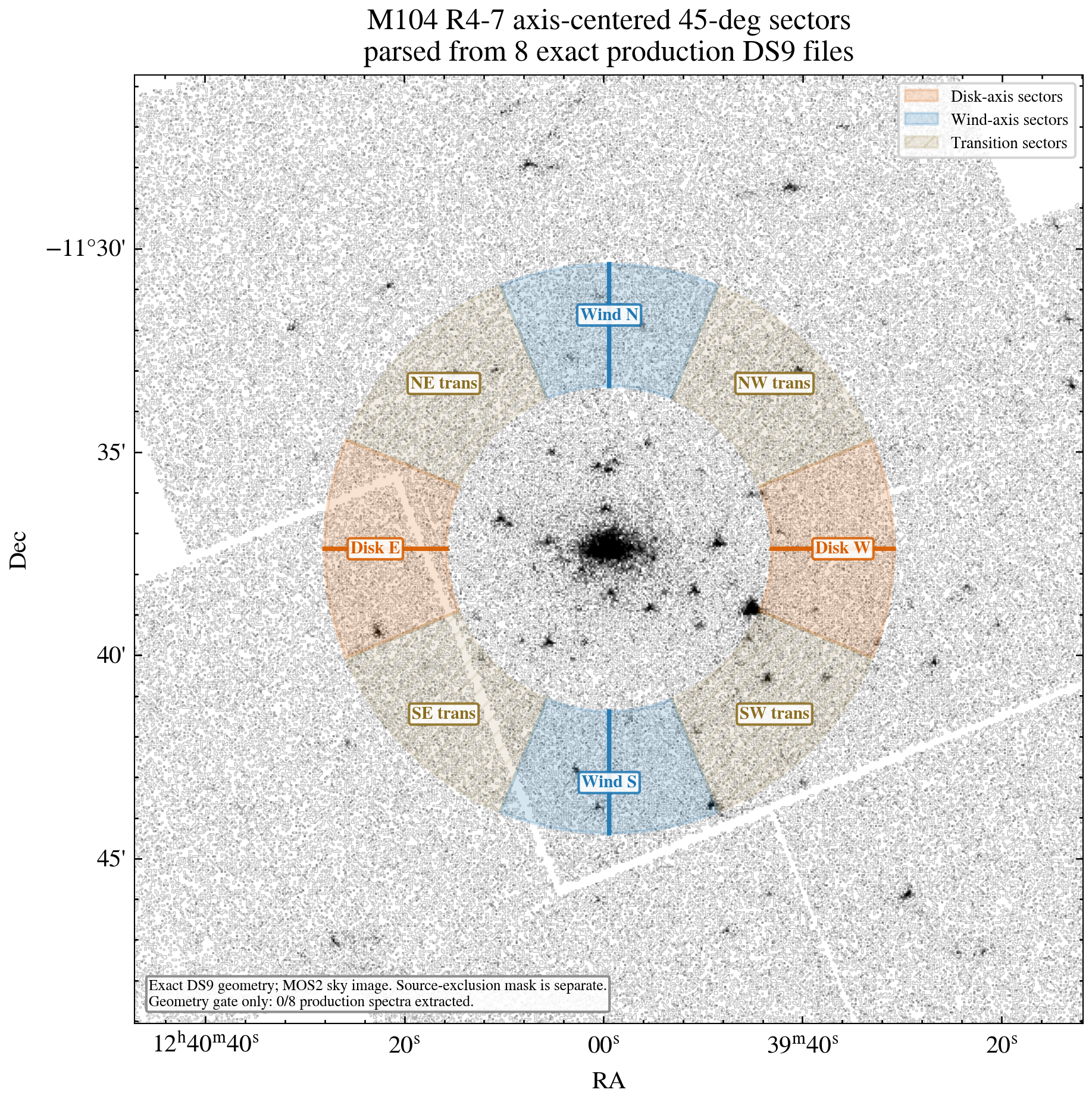
Eight 45° sectors rotated as a whole by 22.5°, so the four physical axes — Disk W/E and Wind N/S — each pass through the center of a complete sector. MOS2 extraction and per-spectrum visual QA are now complete: 7 sectors qualified; S8 remains unavailable because it has only CCD1 and no outer-corner anchor.
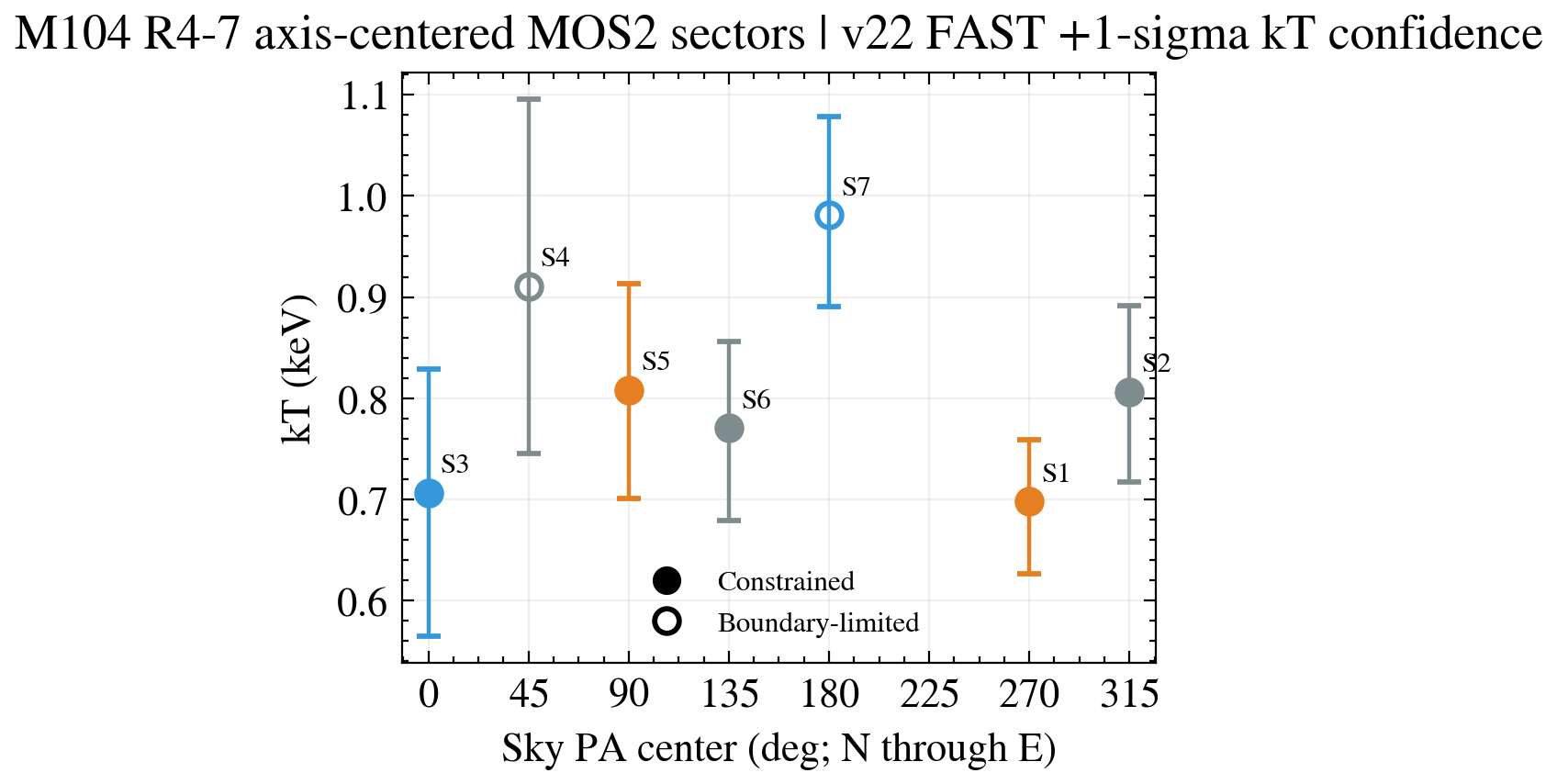
Current status: 7 / 8 qualified MOS2 spectra; S8 unavailable; v22 FAST triage and source-only 1σ kT profile complete: 7 sectors technical pass, 5 constrained, S4/S7 boundary-limited. Final normal/2D confidence not started.
Feasibility
Extraction is possible, but four gates come first
The eight sectors are feasible in counts; the real uncertainty is the outer-corner QPB anchor and final fitting constraints of each 45° region on MOS1/MOS2, not the geometric area itself.
Live progress · 2026-07-11
Phase 2: MOS2 extraction complete; 7/8 qualified (B006 replay unavailable); S8 unavailable
S1–S7 each have region-specific source/QPB/ARF/RMF and a complete no-fit/spatial QA handoff. The Wind N fresh independent review deleg_998c11bd has PASSED; S8 (292.5–337.5°) has only central CCD1, and mos_back per its rules refuses QPB without an outer anchor.
group_subtracted_oversampling_SNR(5,6); data only are shown — no model was constructed or fitted.
qualification JSON
superseded release status JSON
exact DS9 region
detector expression
inspect manifest
overlay manifest
Complete visual QA
Seven qualified sectors: spectra and spatial maps inspected one by one
Per-sector inspection of exact DS9, MOS2 camera/source mask, and three xsherpa no-fit units. All EPIC spectra are y-log, 0.4–3.2 keV, and use group_subtracted_oversampling_SNR(5,6); these QA figures themselves contain no fit — fitting results are in the next section.
v22 temperature triage · 2026-07-12
Can the seven sectors
be fitted for a temperature?
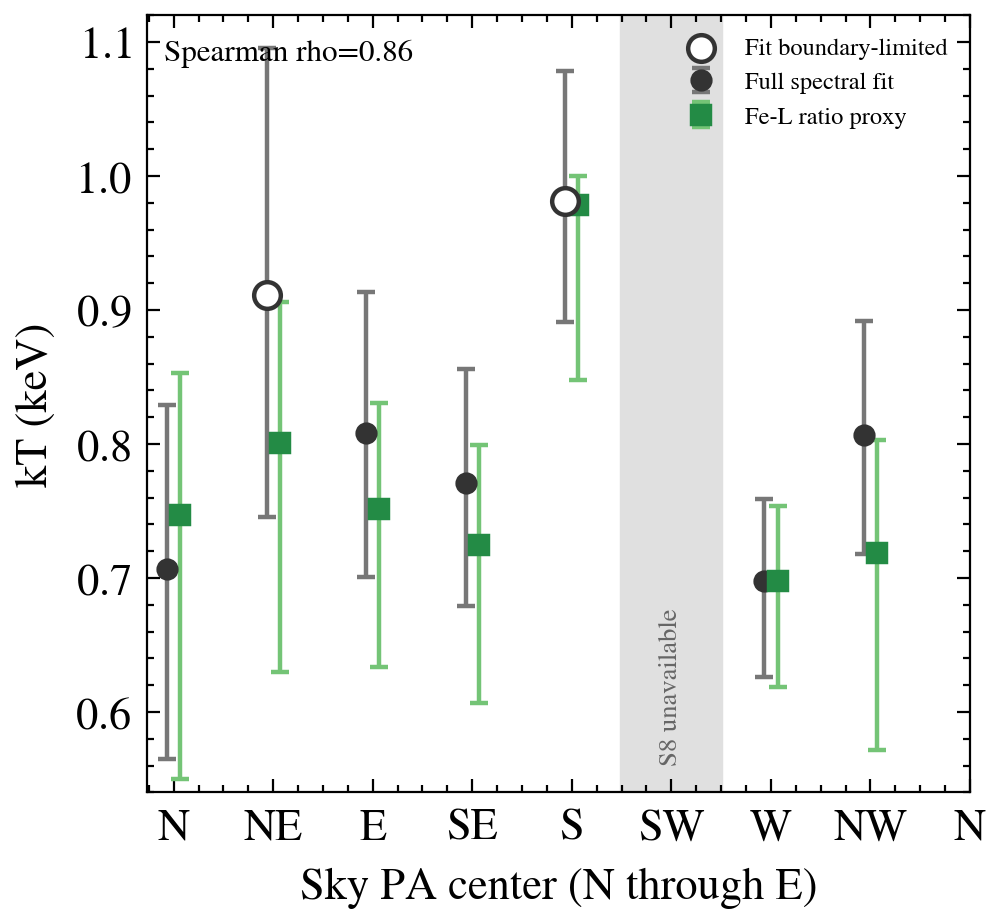
This section preserves the completed historical mosIgn140-200 triage: source SP shape+norm frozen to R0–15, CXB norm free, MOS Line3=0; the effective band is 0.4–3.2 keV excluding MOS 1.4–2.0 keV. It is a FAST triage + source-only 1σ profile, not the final normal/2D confidence. The later controlled 4-vs-7 refit uses the unified 1.15–1.45 keV gap; the two must not be conflated as the same result.
Independent-review remediation (
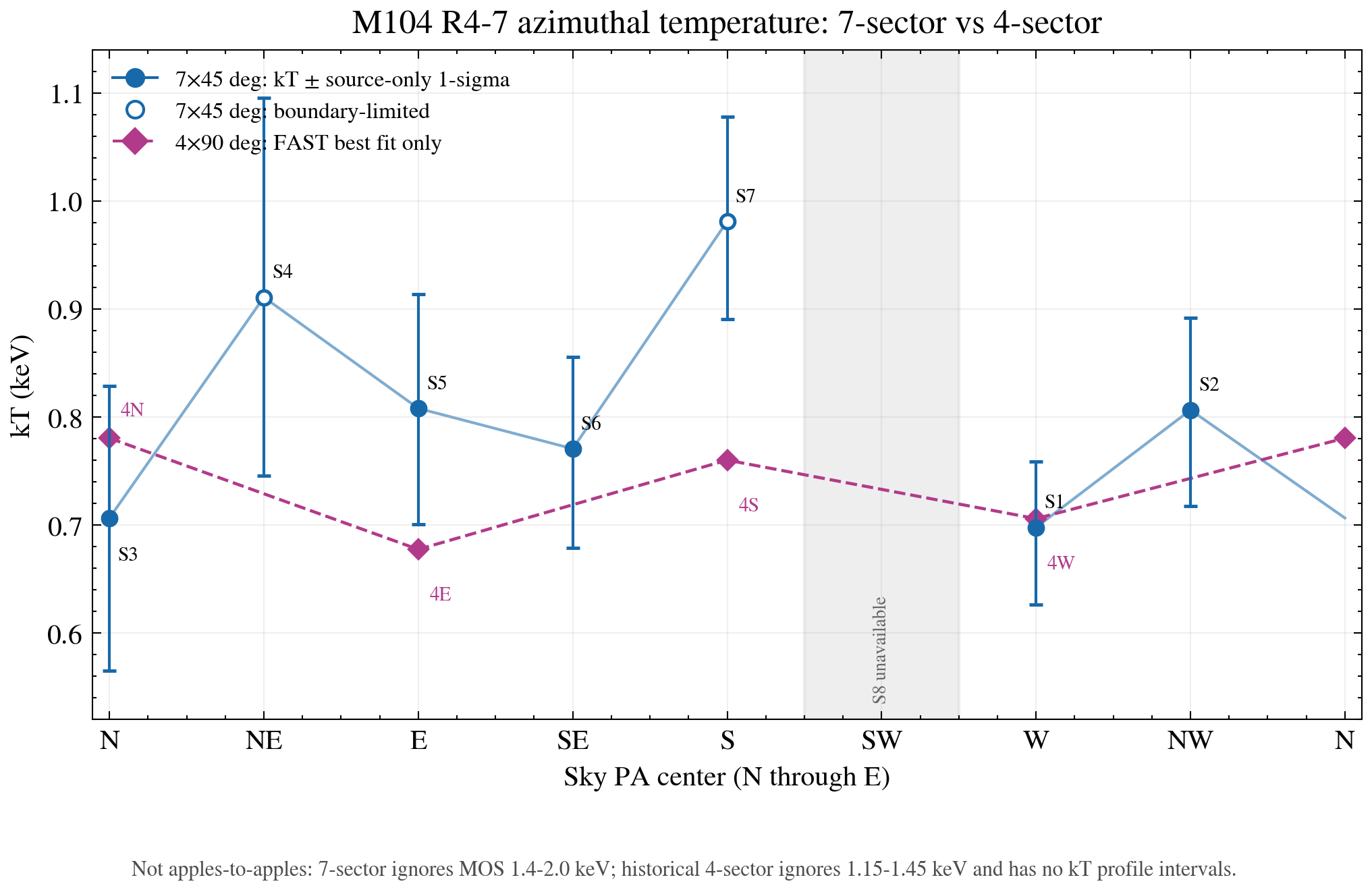
deleg_a559b0b0; follow-ups deleg_26850b86/deleg_eb1a6716/deleg_c8f1c9f8): the final re-run uses the schema-v2 strict manifest; the loader enforces exact 38 runtime data inputs, 7 code dependencies, 7 sectors, role/cardinality/path uniqueness, and a one-to-one sector↔top-level correspondence. All MOS PHA are forced to match the expected OBS_ID and contiguous channels; ARF/RMF are validated for finiteness, positive widths, monotonic ENERG/EBOUNDS, ARF↔MATRIX grid consistency, strictly increasing non-overlapping RMF groups, and zero-groups carrying no positive payload. The fit and confidence runners both reject MAX_JOBS outside 1–3 before creating directories/preflight. Each sector is mutex-protected by flock; session and CSV are published via staging, with the sidecar commit marker completing an atomic commit last. The restore validator item-by-item checks the exact source/QPB/ARF/RMF/RASS inventory, that SP/CXB are indeed in the current active model, that the current sole thawed set is CXB norm/source kT/source norm, and stat/dof/rstat/qval. The release gate compares per-region summary, FAST CSV, the FAST values embedded in constraints, confidence kT, session/sidecar hashes, source PHA and filter, rejecting legal-but-cross-generation mixed artifacts. The deep-semantic-hardened full re-run agrees item-by-item with the previous numbers.kT(4-sector)−kT(7-sector) values along the four principal axes are N +0.074, E −0.131, S −0.221, W +0.008 keV: W agrees essentially, E and S differ more. Not apples-to-apples: the final 7-sector strictly excludes MOS 1.4–2.0 keV, the historical 4-sector excluded only 1.15–1.45 keV, and the angular widths and error contracts differ; this is a diagnostic display only — the differences must not be directly interpreted as true azimuthal temperature differences.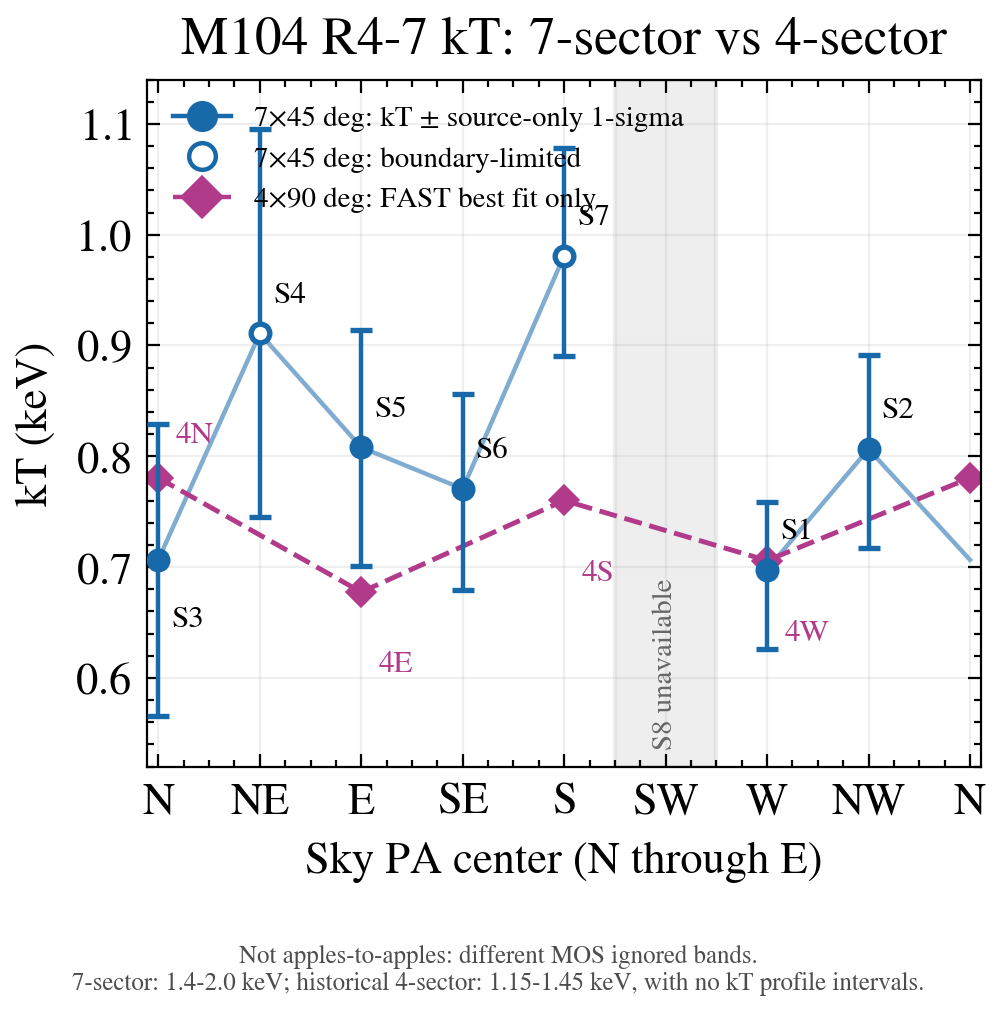
| Sector | Role / PA center | kT (keV) | 1σ interval (keV) | rstat / dof / Q | Constraint |
|---|---|---|---|---|---|
| S1 disk W | 270° | 0.698 | 0.626–0.759 | 0.82 / 17 / 0.675 | constrained |
| S2 NW transition | 315° | 0.807 | 0.718–0.892 | 0.27 / 9 / 0.982 | constrained |
| S3 wind N | 0° | 0.707 | 0.565–0.829 | 0.45 / 6 / 0.844 | constrained |
| S4 NE transition | 45° | 0.911 | 0.746–1.095 | 1.39 / 6 / 0.213 | boundary-limited |
| S5 disk E | 90° | 0.808 | 0.701–0.914 | 0.80 / 7 / 0.588 | constrained |
| S6 SE transition | 135° | 0.771 | 0.679–0.856 | 1.95 / 6 / 0.0685 | constrained |
| S7 wind S | 180° | 0.981 | 0.891–1.078 | 1.16 / 15 / 0.292 | boundary-limited |
Response-folded color diagnostic · 2026-07-12
Which two bands best distinguish
0.7 from 0.8 keV?
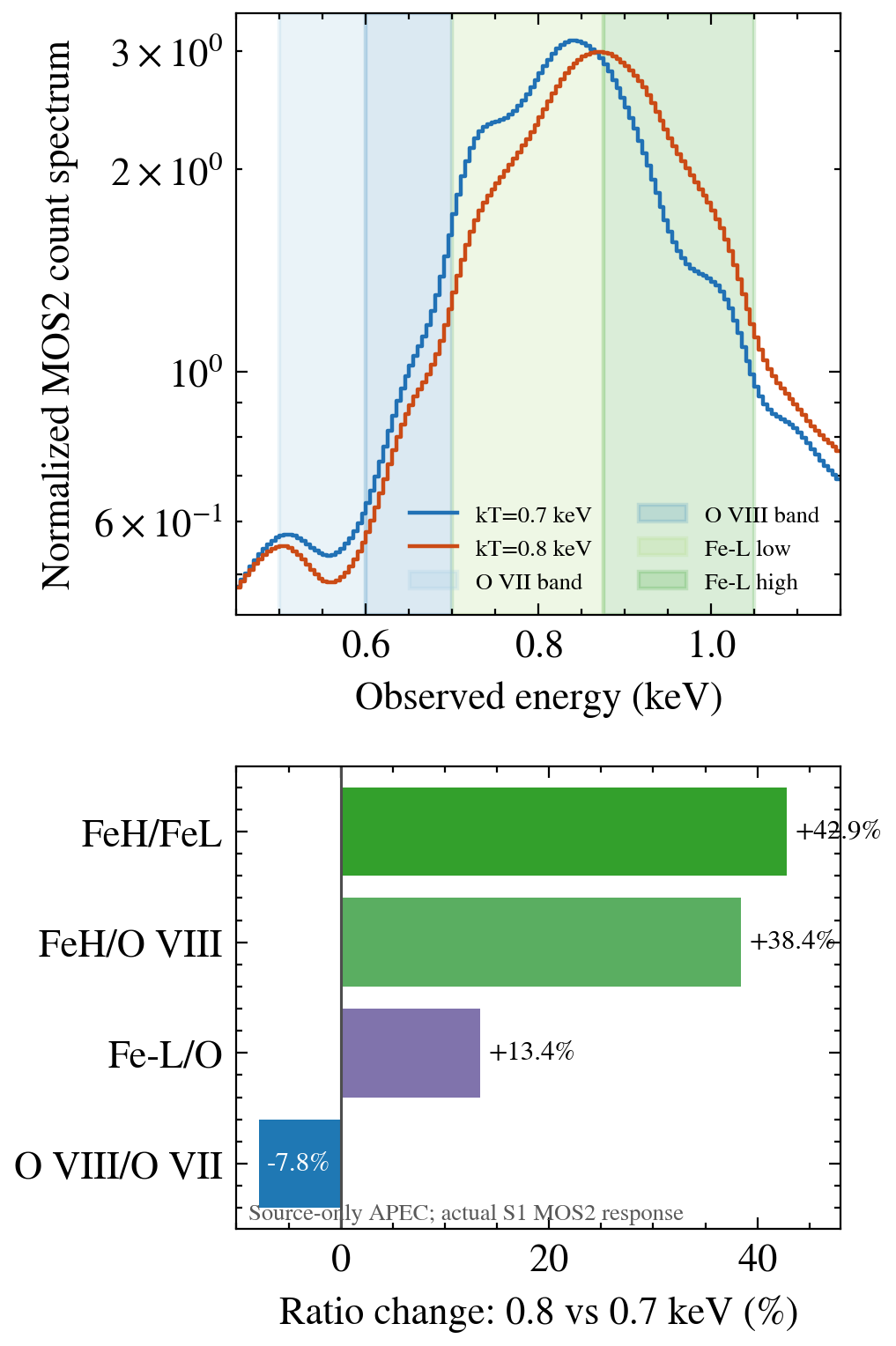
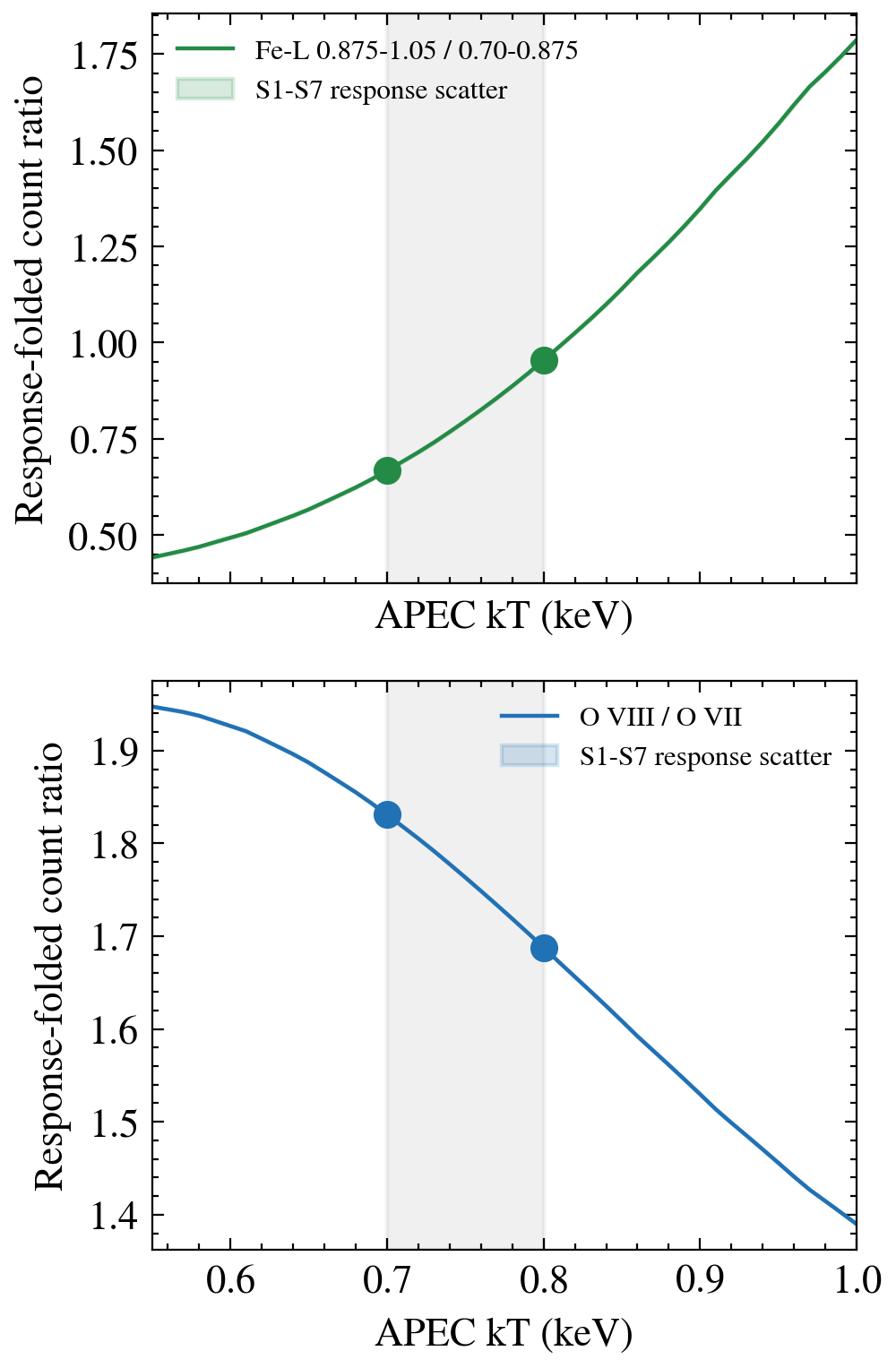
Folding phabs*apec one by one through the seven real MOS2 ARF+RMF sets of S1–S7, with NH=3×1020 cm−2, Z=0.3, z=0.003416 fixed. What is optimized here is the detector count ratio, not the unfolded theoretical line flux.
Why not just use the O VII, O VIII, Fe-L "three lines"? In the current sectors the M104 source contributes only a median 8.5% of the O VII window and 18.5% of the O VIII window; the 0.7-vs-0.8 discrimination of O VIII/O VII has a median of only 0.049σ. Testing Z=0.2–0.5 and NH=(2–4)×1020 cm−2, this ratio changes by up to 12.3%, already exceeding its 7.8% temperature signal. The recommended three-band scheme: O control 0.50–0.70, Fe-L low 0.70–0.875, Fe-L high 0.875–1.05 keV; the main temperature color uses the latter two, with O VII/O VIII only monitoring foreground / absorption consistency. If computed from grouped PHA, grouping breaks must be forced at 0.70/0.875/1.05 keV; the more robust route is to forward-fold in ungrouped PI/counts space.
Exact half-open component imaging · 2026-07-13
Fe-L color map with
point sources retained
Per the user's requirement the main map does not subtract point sources; the discrete PI strictly uses 700≤PI<875 and 875≤PI<1050; data, QPB, SP, and sky background all enter the same spatial grid in counts space, then share a 60″ Gaussian kernel for low/high. It is a morphology cross-check, not a diffuse-gas 2-D temperature map.
adapt separately per band and then dividing is forbidden.Component contract: full-map QPB low/high=1,602.69/1,567.99 counts; sky=1,314.96/984.25; native SP only 21.21/21.67. The R0–15 native MOS2 model closes to 0.9% and 0.4% in the two bands respectively. Applying the MOS1 common-SP seed directly to MOS2 would be 17–22× higher than native SP; it is used only as an over-subtraction stress test.Open the full bilingual methods, equations, sector table, caveats, and downloads page.
Claude Code Opus4.8 high-effort independent audit: the band-ratio color-morphology release after the half-open reconstruction is PASS; the 8-sector spectral publication is REQUEST_CHANGES. S4/S7 remain limited by the 1.0 keV kT ceiling, and the Wind N/S ordering flips between the 4-sector and 8-sector binning — "Wind-S-hot" cannot be stated as a binning-robust quantitative conclusion.Download the full independent audit report.
2col PNG
2col PDF
DS9 manifest CSV
DS9 manifest JSON
verification summary
MOS conversion CSV
wrap negative-control CSV
replayable release JSON
Review-hardened checks: the Monte Carlo now derives PA from the actual DS9 endpoints; a deterministic circular-adjacency and total-span=360° check is added. The converter expression requires exactly one DETX/DETY sector+annulus, radii 4800/8400, finite values; canonical angles are normalized to midpoint∈[-180°,180°). The positive wrap
337.5→22.5 = 315°, rejected; the negative-angle wrap -22.5→22.5 = 45° is accepted. All 48 conversions across the six MOS exposure detector images and the 6 wrap-control sets pass. MOS2 WCS planning counts assigned=2,547, unassigned=0, multiply-assigned=0; the eight centroids are 0.82–4.20° from their sector centers. Release m104-r47-eight-axis-centered-phase1-v1 records absolute paths, sizes, and SHA-256 of 6 code files, 11 FITS inputs, and 20 outputs; the tests recompute each item to reject stale mixed products.Exact geometry
Eight 45° regions,
axis-centered
All boundaries are shifted 22.5° relative to the old scheme, placing the disk / wind axes at sector centers. File names record the DS9 pie angle; physical directions continue to use sky PA = DS9 angle − 90°.
| region basename | DS9 pie geometry | Actual sky PA | Physical role | Sector center | MOS2 700–1000 eV planning counts | detector expectation |
|---|---|---|---|---|---|---|
Angle337.5-22.5 | pie(-22.5,22.5) | 247.5–292.5° | Disk W | W · 270° | ≈430 | MOS2 candidate; MOS1 unavailable expected |
Angle22.5-67.5 | pie(22.5,67.5) | 292.5–337.5° | NW transition | NW · 315° | ≈265 | MOS2 candidate; MOS1 unavailable expected |
Angle67.5-112.5 | pie(67.5,112.5) | 337.5–22.5° | Wind N | N · 0° | ≈231 | MOS2 candidate; MOS1 unavailable expected |
Angle112.5-157.5 | pie(112.5,157.5) | 22.5–67.5° | NE transition | NE · 45° | ≈239 | MOS1+MOS2 candidate; per-region check |
Angle157.5-202.5 | pie(157.5,202.5) | 67.5–112.5° | Disk E | E · 90° | ≈279 | MOS1+MOS2 candidate; per-region check |
Angle202.5-247.5 | pie(202.5,247.5) | 112.5–157.5° | SE transition | SE · 135° | ≈261 | MOS1+MOS2 candidate; per-region check |
Angle247.5-292.5 | pie(247.5,292.5) | 157.5–202.5° | Wind S | S · 180° | ≈349 | MOS1+MOS2 candidate; per-region check |
Angle292.5-337.5 | pie(292.5,337.5) | 202.5–247.5° | SW transition | SW · 225° | ≈493 | MOS1+MOS2 candidate; per-region check |
Counting note: these values come from the MOS2 700–1000 eV ESAS source-image mosaic of the four qualified parents, split read-only along the corrected sky-PA boundaries; 2,547 counts total with no leakage across the eight regions. They serve feasibility only — formal counts must come from the exact detector expressions converted from the new DS9 files; this table must not be treated as PHA counts or fit results.
Execution plan
A four-stage pipeline from geometry to temperature
Every stage is a fail-closed gate. If the previous step did not pass, the next is not started; any partial directory is quarantined first and never mixed with production products.
Generate and verify regions · PASS
- An independent directory
R4-7_eight_axis_centered_45deg_sectorswas established, without overwriting the existing four-sector products or the deprecated boundary-aligned plan. - 8 DS9 FK5 files, a combined display file, and a manifest with DS9 angle, sky PA, central direction, and axis/transition roles were output.
- The 2,000,000-point Monte Carlo passed: full-annulus union=1, gap=0, overlap=0; the centers of the four axis bins fall on W/N/E/S respectively.
- This is an independent partition rotated 22.5° from the old 90° parents; no requirement exists that any two new sectors reconstruct an old parent.
- All 48
ds9_to_xmmexprconversions over the 6 MOS exposure detector images yield 45° detector sectors. - The actual DS9 overlay passed machine/WCS/human confirmation; the Phase 2 gate was lifted.
Production ESAS extraction · COMPLETE / 7 QUALIFIED
- S1–S7 each have source/QPB/ARF/RMF and passed qualification; S8 unavailable.
- S8 has only CCD1;
mos_backskipped it per the fail-closed rule; no parent-scaled/surrogate QPB was constructed. - Wind N replay-verified; the other 6 regions accepted via the B006 production-only QPB path.
- All qualified products come from region-specific
mos-spectra+mos_backsource / QPB / ARF / RMF. - Per-region command CCDs, EXPOSURE, BACKSCAL, counts, RMF/ARF, and PN exclusions were verified.
Per-spectrum QA handoff · PASS
- The 7 regions' exact DS9 FK5/RA-Dec regions and converted detector expressions are all retained.
- 42 spectrum PNGs, 42 paired PDFs, and 14 spatial overlay PNGs complete.
- All spectra are no-fit xsherpa.inspect; all spatial maps overlay the exact region + actual camera/source mask.
- 7 four-panel sector QA cards and 4 overview atlases were visually inspected.
Homogeneous refit and axis control
- The approved four-sector values and the existing
mosIgn140-200seven-sector triage are retained as non-overwritten historical baselines; new results use independent, long, explicit output suffixes. - Following the v22 source/background topology: R0–15 SP shape+surface norm frozen, CXB norm free.
- The user-selected unified contract is MOS2-only, excluding 1.15–1.45 keV, MOS Line3 (≈1.3 keV) norm=0; the energy gap and the Gaussian cancellation are two independent operations. Al/Si instrumental lines are not a universal forbidden band for MOS analysis and continue to be handled explicitly per branch.
- Re-run the four 90° controls and the seven 45° sectors under identical grouping, background, free/frozen parameters, and source-only confidence definitions, without overwriting old sessions.
- FAST_MODE triage first; normal/confidence only for sectors passing technical and science QC.
- The final report will state the four axis-centered 45° temperatures, four transition temperatures, the corresponding 90° axis controls, detector composition, and confidence status; it will no longer claim that new sectors can pairwise reconstruct the old parents.
Current evidence
The plan is based on real four-sector products
Below is the current actual ESAS source-image overview. The corrected 45° partition is rotated 22.5° relative to these 90° hatches: the four axis bins sit at hatch centers, the four transition bins straddle adjacent hatch boundaries. This figure does not replace the Phase 1 exact-region overlay.
Actual extraction audit
Verifying each
mos-spectra companion image
Not just region file names: the audit binds directly to the PHA used in the fit, mos*-obj-im-700-1000.fits, MASK, the copied/standard DS9 regions, and rProfile. The historical four sectors have 6 camera-region products, the final S1–S7 have 7, 13 in total.
Quantitative conclusion: all 13/13 PHA/image identities, detector annulus/sector widths, active DS9 geometry, image/MASK WCS, and image/
rProfile total counts agree; relative to the M104 center, within a 2.5-arcsec pixel tolerance, the positive pixels crossing the R4/R7 or PA boundaries are all zero. Wrong-region extraction can therefore be excluded from the explanation of the 4-vs-7 temperature differences. Two provenance caveats: the historical four product-directory region annotations suffered an old label misalignment, but the active pie(...) and the actual images are correct; the surviving rProfile radial axis is centered on the FITS RA_OBJ/DEC_OBJ, 2.134′ from the M104 center — it can only be used for its spatial panels/total counts in verification, not to judge the M104 R4–7 boundaries from its radial axis.

Go / no-go
Stop, merge, and publication gates
"Extraction succeeded" does not mean "the eight-point temperature map is credible". Technical availability, fit constraints, and physical interpretation must be recorded separately.
Stop immediately
Geometry gap/overlap, 45° converter width errors, physical labels inconsistent with WCS, missing QPB, CCD1-only without outer anchor, any missing source/QPB/response.
Keep but mark Questioned
kT touching a boundary, confidence failure, obvious camera residual conflicts, insufficient source/background constraints, anomalous fit statistic. Questioned points cannot be used to claim 45° temperature structure.
Fall back when necessary
If an axis-centered sector is unavailable, fall back to the corresponding verified 90° axis control; if a transition sector is unavailable, record the explicit gap or design a separate symmetric rebin. No arbitrary adjacent new sectors may be spliced into an old parent, and no surrogate fills the 8 points.
Delivery contract
Final deliverables
After each stage the same Cloudflare Pages report and the M104 Discord thread are updated, keeping plan, regions, spectra, and fit results in one place.
Geometry package
8 DS9 FK5 regions, combined file, CSV/JSON manifests, MOS1/MOS2 detector expressions, 1col+2col overlay PNG/PDF, and the WCS regression test.
Spectrum QA package
Qualification manifest, source/QPB/ARF/RMF paths and hashes for every qualified camera/sector, no-fit inspect figures, region+camera-mask real-XMM overlays.
Temperature package
8-sector kT polar/linear plots (1col+2col), spectrum+residual atlas, parent-control comparison, QC classification, and a mobile-readable Cloudflare HTML.